Aircond Not Cold Enough? Here Is What to Check
Your aircond is running but not cooling properly? Check these 8 common causes before calling a technician. Some fixes you can do yourself right now.
Why Your Aircond Is Running But Not Cooling
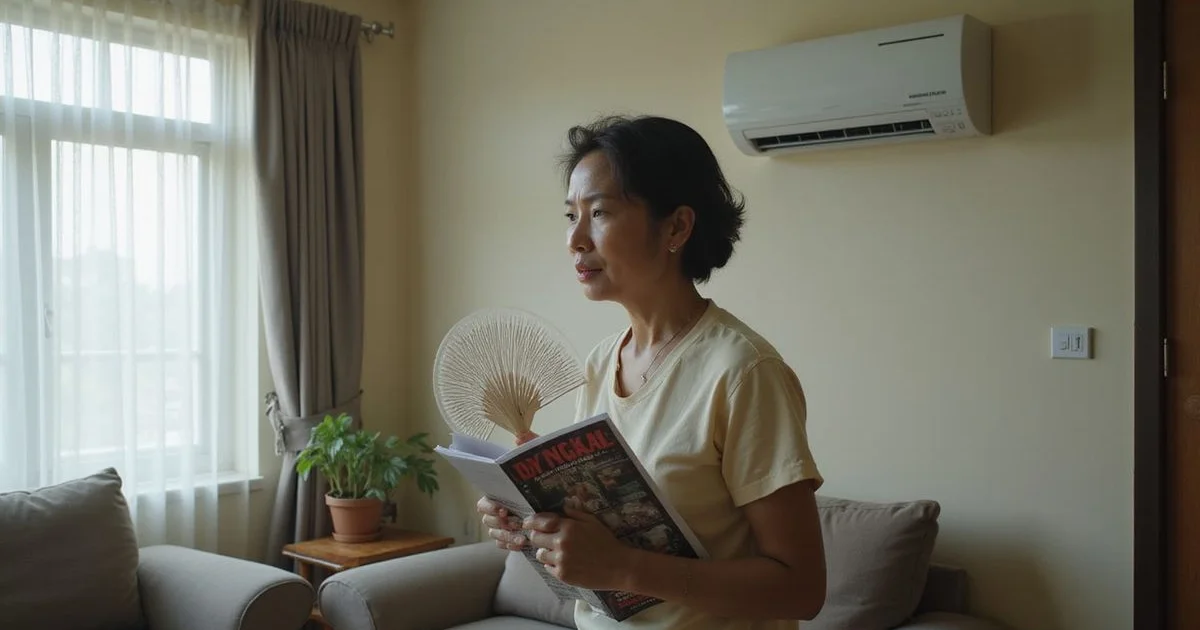
You know the feeling. You walk in from the humid Kuala Lumpur heat expecting relief, only to find your living room feels more like a sauna. The air conditioner is humming, the flaps are open, but the air coming out is barely lukewarm.
It is a frustrating scenario that affects thousands of homeowners across Petaling Jaya and the Klang Valley every year. A malfunctioning unit impacts your sleep, your electricity bill, and your patience.
Most people assume this means they urgently need professional aircond repair or a costly gas top-up immediately.
That is often not the case.
Based on our years of servicing units from Mont Kiara to Subang Jaya, we have found that simple maintenance issues cause over 70% of these problems. We are going to walk you through the diagnostic process our own technicians use. Some of these checks are simple DIY tasks, while others will help you understand exactly what to ask for when you call a professional like our team at PJ Kool Aircond Service.
Check 1: Dirty Air Filters
Difficulty: Easy (DIY)
This is the single most common reason for poor cooling performance in Malaysian homes. Your air conditioner works by pulling warm air from your room, cooling it over the coils, and pushing it back out.
If the filter is clogged, that airflow stops.
A choked filter can reduce your unit’s efficiency by 5% to 15%, according to energy data. This forces the compressor to work overtime, driving up your TNB bill while cooling your room less effectively.
The “Torch Test”
How do you know if it is too dirty?
- Open the front panel.
- Pull out a filter.
- Hold it up against a light source or your phone’s torch.
- If you cannot see the light clearly through the mesh, it is blocked.
What to Do
- Open the front panel of your indoor unit.
- Slide out the air filters carefully to avoid shaking dust onto the furniture.
- Wash them under running water. Use a soft sponge if the dust is sticky (common in kitchens).
- Allow them to dry completely in a shaded area before reinstalling.
- Pro Tip: Do not dry them in direct hot sun, as this can warp the plastic mesh.
Clean your filters every two weeks if you use the unit daily.
Check 2: Dirty Evaporator Coil
Difficulty: Requires Professional Service
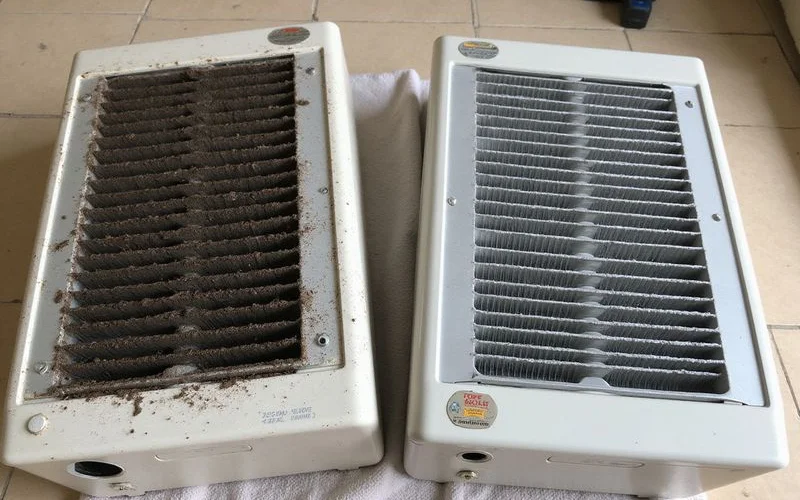
Filters catch the big dust bunnies, but microscopic particles still pass through. Over time, these particles mix with the condensation on your cold evaporator coils to form a “jelly-like” slime.
This layer of grime acts as an insulator. It prevents the refrigerant in the coils from absorbing the heat from your room.
Signs This Is Your Problem
- The Delta T is low: If you measure the air going in versus the air coming out, the difference is less than 8°C.
- Musty smell: A sour or moldy odour often accompanies a dirty coil.
- Visible blockage: You can see dark residue or “fur” on the silver fins behind the filters.
The Fix
A standard water cleaning is rarely enough for established grime. The most effective solution is a chemical wash. At PJ Kool Aircond Service, we use alkaline-based coil cleaners that foam up to push dirt out from between the tight aluminium fins without corroding them.
Check 3: Low Refrigerant (Gas)
Difficulty: Requires Professional Service
There is a common misconception that air conditioner gas “runs out” like petrol in a car.
It does not.
Refrigerant circulates in a closed loop. If your gas level is low, it means you have a leak.
Identifying the Gas Type
Knowing which gas your unit uses helps you estimate costs.
- R22: Found in units older than 10-12 years. It is being phased out and is expensive to top up.
- R410A: Common in units installed between 2010 and 2020.
- R32: The current standard for new units (Daikin, Panasonic, Acson). It is more efficient and generally cheaper to refill.
Signs of Low Refrigerant
- Ice build-up: You see white frost on the copper pipes near the outdoor unit or on the indoor evaporator.
- Hissing sound: A distinct hiss from the indoor unit indicates a gas leak.
- Gradual decline: The cooling got worse slowly over several weeks.
The Fix
A technician must attach a manifold gauge to check the pressure (PSI). If it is low, topping up is only a temporary band-aid. We always recommend locating the leak—usually at the flare nuts or joints—and repairing it before adding new refrigerant. A proper repair in the Petaling Jaya area typically ranges from RM150 to RM250, depending on the leak’s severity and gas type.
Important: Simply topping up the gas without fixing the leak guarantees you will face the same problem again in a few months.
Check 4: Blocked or Dirty Outdoor Unit
Difficulty: Moderate (Partial DIY)
The outdoor unit (condenser) has a tough job. It sits in the Malaysian heat and tries to release the heat it absorbed from your house.
If the condenser is choked with dirt, or if the air around it cannot circulate, the heat stays in the system. This often causes the compressor to overheat and shut down (trip) as a safety measure.
The “Short-Cycling” Risk
This is common in condos where compressors are stacked in small utility yards. If the hot air from the unit hits a wall and bounces back into the intake, the unit suffocates.
What to Check
- Clearance: Is there at least 50cm of clear space in front of the fan?
- Cleanliness: Look at the back of the unit. Are the fins clogged with leaves, dog hair, or construction dust?
- Heat Traps: Is the unit in an enclosed balcony with the windows shut?
What to Do
- Clear any boxes, potted plants, or drying racks away from the unit.
- Gently rinse the condenser fins with a garden hose using low pressure. High pressure can bend the delicate fins and ruin the unit.
- Open the windows in your service yard to improve ventilation.
Check 5: Wrong Temperature or Mode Settings
Difficulty: Easy (DIY)
It sounds simple, but incorrect settings are a frequent culprit. Modern remotes have many buttons, and pressing the wrong one can disable the cooling function entirely.
Critical Settings to Verify
| Setting | Correct Mode | Why it matters |
|---|---|---|
| Mode | COOL (Snowflake icon) | “Dry” mode reduces humidity but limits cooling power. “Fan” mode just blows air. |
| Fan Speed | High or Auto | Low fan speed cannot push the cold air across the room fast enough. |
| Temperature | 23°C - 24°C | Setting it to 16°C forces the unit to run non-stop, which can freeze the coils. |
The “Sleep” Mode Trap
Check if the “Sleep” or “Eco” mode is active. These modes gradually raise the temperature by 1°C to 2°C per hour to save electricity, which might be why you wake up sweating at 3 AM.
Check 6: Room Is Too Large for the Unit
Difficulty: Requires Assessment
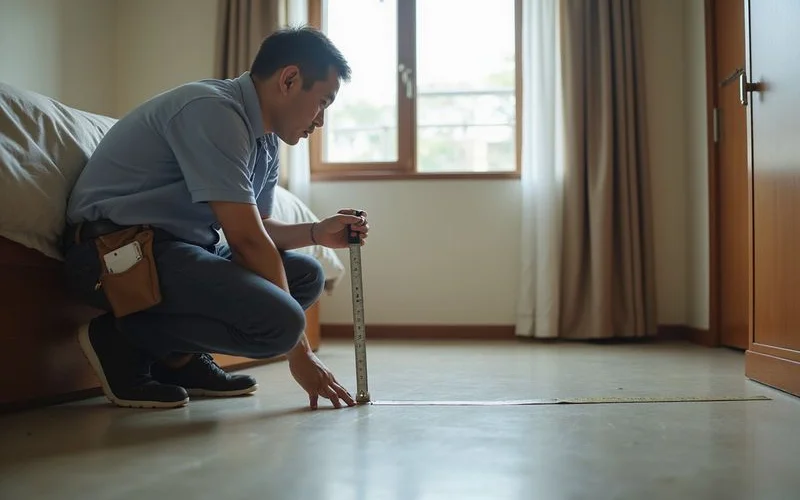
An undersized air conditioner is like trying to cool a warehouse with a desk fan. It will run continuously, drive up your energy bill, and never reach the set temperature.
This issue is prevalent in open-concept renovations where walls have been knocked down, increasing the total cooling volume.
Updated HP Guidelines for Malaysian Homes
These recommendations assume a standard ceiling height (9-10 ft). If you have double-volume ceilings or large West-facing windows, you need to size up.
| Room Size | Recommended HP | Best For |
|---|---|---|
| Small bedroom (100-150 sq ft) | 1.0 HP | Study room, kids’ room |
| Standard bedroom (150-250 sq ft) | 1.5 HP | Master bedroom |
| Master bedroom (250-350 sq ft) | 2.0 HP | Large master with ensuite |
| Living room (350-500 sq ft) | 2.5 HP | Standard condo living hall |
| Large living/open plan (500+ sq ft) | 3.0 HP or 2x units | Landed property living hall |
If your unit is undersized, servicing will not help. You will need to upgrade the unit or install a secondary unit to share the load.
Check 7: Compressor Issues
Difficulty: Requires Professional Diagnosis
The compressor is the heart of the system. If it fails, the “blood” (refrigerant) stops moving, and cooling stops instantly.
Compressors generally last 8 to 12 years. If your unit is in this age range and stops cooling, the compressor might be nearing the end of its life.
Signs of Compressor Problems
- The “Hard Start”: You hear a loud clicking or shaking sound when the outdoor unit tries to turn on.
- Fan but no hum: The outdoor fan spins, but you don’t hear the deep hum of the compressor running.
- Tripping: The main circuit breaker (MCB) trips immediately when you turn the aircond on.
The Fix
Repairing a compressor is complex. Replacing the capacitor (a small starter component) is cheap, usually under RM180. However, replacing the actual compressor costs between RM800 and RM2,000. For an older non-inverter unit, it is often more economical to replace the entire system with a new, energy-efficient model.
Check 8: Hot Air Infiltration
Difficulty: Easy (DIY)
Sometimes, your air conditioner is fine. The problem is your room.
If heat is entering the room faster than the air conditioner can remove it, the temperature will never drop. In Malaysia, “phantom heat” sources are a major issue in older homes.
Common Heat Sources
- Jalousie Windows: The glass slats common in older kitchens seal very poorly, letting in massive amounts of warm air.
- Uninsulated Roofs: If you live on the top floor, ceiling heat radiation can reach 40°C or more.
- Electronics: Gaming PCs and large TVs generate significant heat that fights against your AC.
Try using blackout curtains during the hottest part of the day (1 PM - 4 PM). This simple change can drop the room temperature by 2°C to 3°C, taking a huge load off your air conditioner.
When to Call PJ Kool Aircond Service
You have checked the filters, verified the remote settings, and cleared the outdoor unit. If the air is still warm, you are likely dealing with a refrigerant leak or a component failure.
This is where we step in.
Our technicians at PJ Kool Aircond Service do not just wash filters; we perform a full 14-point check to diagnose the root cause of the heat. We serve all areas across Petaling Jaya and the Klang Valley with transparent pricing and fast response times.
Contact us today to get your home cool again before the next heatwave hits.